The best feature adoption software in 2026 is Frigade if you want nudges that keep working when your UI changes: Frigade Engage covers announcements, tooltips, banners, and checklists free up to 250 MAUs and $300 a month after that, and the Frigade Assistant surfaces underused features to the accounts that haven't tried them and walks users through them. Pendo and Userpilot are best for analytics-driven targeting, Appcues and Chameleon for hand-designed nudges aimed at segments, UserGuiding for the lowest entry price, and WalkMe and Whatfix for enterprise rollouts across many internal apps.
| Tool | How it targets nudges | Starts at | Best for |
|---|---|---|---|
| Frigade | Live product state (Assistant), segments and events (Engage) | Engage free up to 250 MAUs, $300/mo; Assistant $1,000/mo | Teams that ship weekly and want nudges that adapt to the UI |
| Pendo | Product analytics events | Free up to 500 MAUs, then quote | Analytics orgs running adoption campaigns |
| Userpilot | Segments and events | $299/mo | Growth teams that want flows and analytics in one tool |
| Appcues | Segments | Custom, by usage | PM or CS teams that want a mature no-code editor |
| Chameleon | Segments | $279/mo for 2,000 MTUs | Design-heavy teams that style every nudge |
| UserGuiding | Segments | $249/mo | Early-stage teams on a budget |
| WalkMe | Events, across many apps | Quote based | Enterprise rollouts of software you don't own |
| Whatfix | Events, across many apps | Quote based | Employee training across internal apps |
Prices are from each vendor's pricing page in November 2026.
Every feature adoption tool answers the same question differently: how does the nudge decide who sees it, and when? That decision, more than any feature checklist, determines whether your users discover what you shipped or reflexively dismiss another popup.
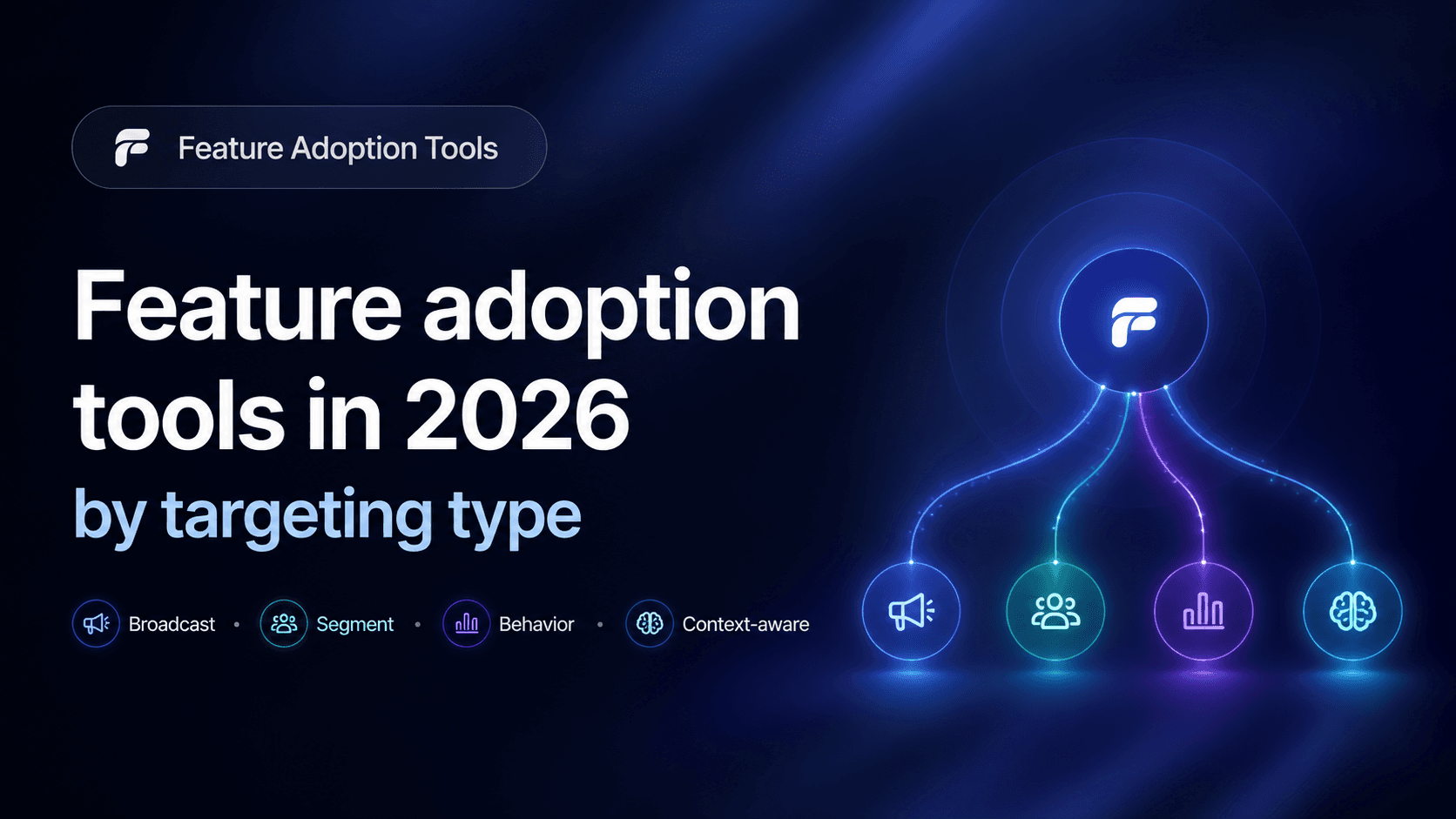
So instead of ranking eight vendors that mostly do overlapping things, this guide sorts the market by targeting precision. It starts at broadcast announcements everyone sees and ends at context-aware nudges that adapt to live product state, with segments and behavioral triggers in between. Each tier has real examples from products you know, because we maintain a library of onboarding patterns captured from production SaaS, and the difference between tiers is easier to see than to describe.
The other three tiers are not straw men, and a product running two or three of them at once is normal.
This is the changelog entry, the launch banner, and the announcement modal on next login. There is no targeting. You ship it and every user gets it.
This tier is underrated when the feature affects every account. 1Password's feature announcement is a dismissible multi-page modal with an interactive list of things to try, and it works because the feature applies to every user of the extension. Figma's announcements and Linear's new-feature drops follow the same logic: broad feature, broad blast, polished execution.
Where it falls apart is frequency, because users tolerate roughly one broadcast a month. Products that broadcast every feature train users to close modals without reading, and then the one announcement that mattered dies with the rest.
The tooling for this tier is your app's own banner component, an email tool, or the announcement modules in any of the platforms below. If broadcast is all you need, you don't need a dedicated purchase. Buying a full adoption platform to send monthly announcement modals is how teams end up paying five figures for a changelog.
This is the classic flow-builder tier, and it's where most of the recognizable vendors live: Appcues, Userpilot, Chameleon, UserGuiding. You define a segment (plan tier, signup date, role, hasn't-used-feature-X), build a tooltip, hotspot, or checklist in a visual editor, and attach it to elements in your UI.
Done well, this looks like Cal.com's checklist and feature promos or GitHub's inline banners, which promote a capability exactly where the relevant users already are. Mercury's feature adoption announcements are another clean version: targeted, dismissible, on-brand.
The costs are real, though. You author and maintain every nudge: each one is anchored to a CSS selector that breaks when your UI changes, and in a product that ships weekly the fix-the-broken-tooltips chore becomes real work. Segments are also a proxy rather than the truth. "Enterprise users who haven't tried the API" still catches the person mid-demo, mid-crisis, or mid-churn, because the segment can't see what they're doing right now.
Pricing spans from UserGuiding at $249/mo to Userpilot at $299/mo to Appcues and Chameleon at annual contracts in the four-to-five-figure range. If your product UI is stable and your team has the discipline to prune stale flows, this tier is a fine long-term home.
This tier is one step up in precision because the trigger reads product analytics instead of static segments. Pendo is the archetype, with Userpilot competing hard on the same loop: find the underused feature in the analytics, aim a guide at the users who skip it, measure whether adoption moved.
Google's feature promos and Brex's product education show the pattern: the nudge lands after you've done something that signals you'd benefit, which is why it feels less random than a segment blast.
The cost is the stack behind it. Analytics-driven targeting is only as good as the event instrumentation feeding it, and the loop (instrument, analyze, build guide, measure) has enough steps that the teams we talk to typically run one campaign a quarter. Pendo is quote-based and typically lands well above the self-serve tier; for larger orgs consolidating adoption analytics and guidance in one contract, that's often still the right buy.
The newest tier, and the one AI actually changed. Instead of segments or event history, the nudge reads what's on the user's screen and what their account has and hasn't done, live. Nothing is anchored to selectors, so nothing breaks when the UI ships.
This is what Frigade's Suggestions do. You describe what you want users to discover, and the assistant surfaces it to the accounts that haven't used it, at the moment they're in the relevant workflow, then walks them through it or does the step for them. The closest hand-built equivalent is Figma's AI feature hint, a contextual prompt that appears exactly when the relevant tool would help. The difference is that Figma builds each of those by hand, on a platform team the buyers of this category do not have.
This tier is young. The Frigade Assistant starts at $1,000 a month, and Frigade Engage covers segment-targeted nudges free up to 250 MAUs and $300 a month after that. If you want pixel-level authoring control over every nudge, tier 2 gives you more of it. The claim is narrower and stronger: the targeting keeps working while you ship, because it isn't pinned to a snapshot of your UI.
| Your situation | Start with | Tools |
|---|---|---|
| A few big launches a year, stable UI | Broadcast + one segment tool | In-house banners, UserGuiding, Appcues |
| Marketing/CS owns adoption, no eng time | Segment-targeted | Userpilot, Chameleon, Appcues |
| Analytics org, quarterly adoption campaigns | Behavior-triggered | Pendo, Userpilot |
| Ship weekly, tooltip maintenance already hurts | Context-aware | Frigade |
| Enterprise, many internal apps | Behavior-triggered DAP | WalkMe, Whatfix |
The tiers stack. A broadcast for the annual redesign, segment checklists for onboarding cohorts, and context-aware nudges for feature discovery is a normal 2026 stack, and cheaper than forcing one tool to do all four jobs badly.
Software that prompts existing users to discover and use features they haven't tried, through in-app nudges like tooltips, announcements, checklists, and contextual suggestions. It overlaps with onboarding tools, but the job is features people miss after signup, rather than first-run setup.
Match the tool to how it targets. For hand-designed nudges aimed at segments, Chameleon and Appcues give you the most authoring control. For analytics-driven targeting, Pendo and Userpilot. For nudges that adapt to live product state without per-element maintenance, Frigade is the AI-native option.
Userpilot, Pendo, Appcues, and Chameleon all trigger on user properties and event history. The newer approach reads live, per-account product state rather than recorded events, which is the model Frigade uses. The practical difference shows up when your UI changes: event-based triggers keep firing on stale anchors, state-based ones adapt.
Move down the targeting tiers. Broadcast only what applies to every account, and make everything else conditional on segment, behavior, or context. Cap frequency, keep every nudge dismissible, and delete stale flows on a schedule. The pattern examples above from 1Password, Mercury, and GitHub are worth copying: all three are dismissible, specific, and shown in the location where the feature lives.
Yes. The current generation of AI feature-discovery tools reads account state and surfaces the feature a user is most likely to need next, instead of requiring you to define every segment and trigger. Frigade's Suggestions work this way. Much of the rest of the market is adding AI that helps you author nudges faster, while the targeting itself stays segment-based, so check which of the two a vendor means by "AI."