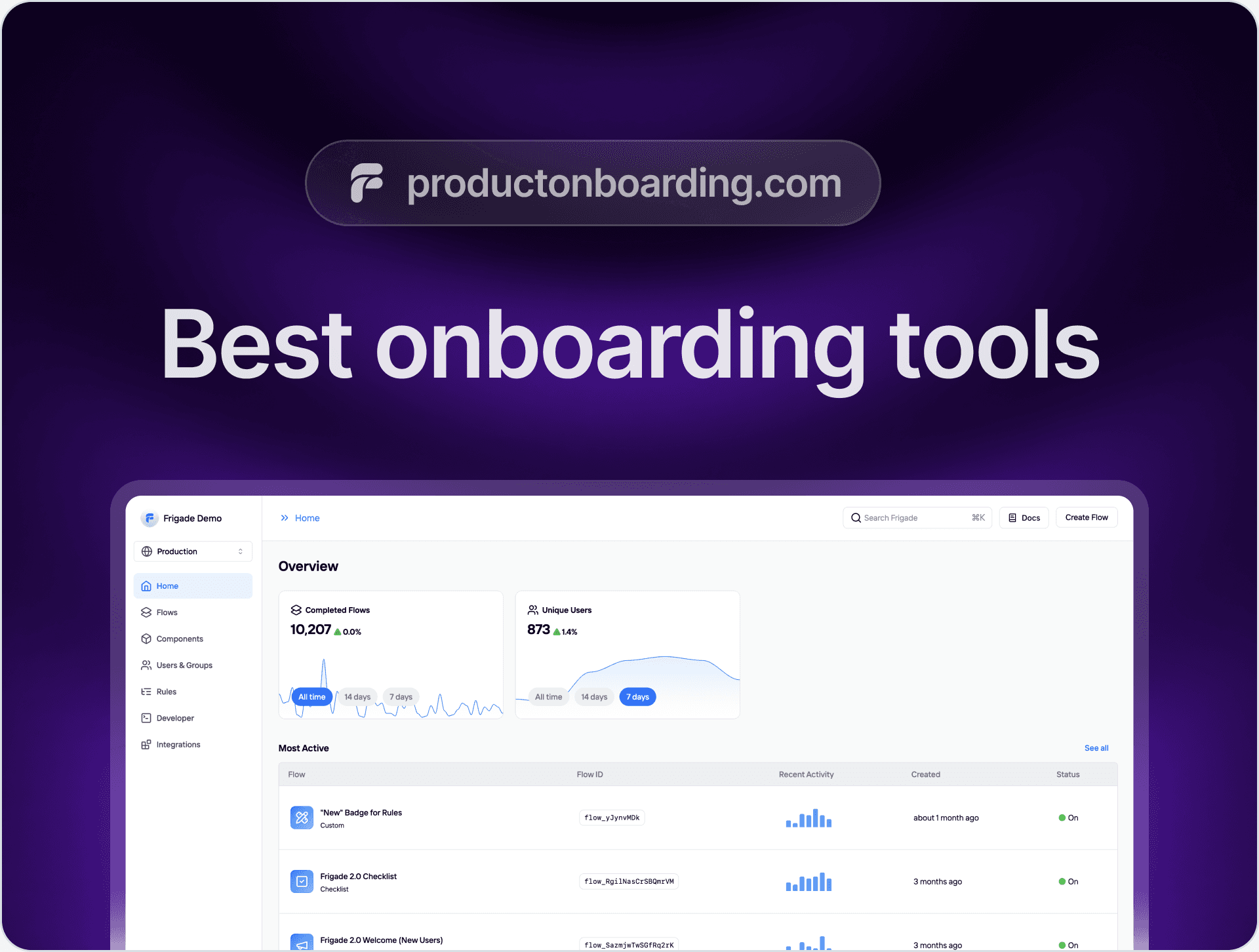
The best product adoption platform in 2026 is Frigade Assistant if you want an AI product adoption platform: an assistant that learns your product, answers users inside it, and takes the action with them, with no flows to author. Pendo is the pick when product analytics is the main purchase, Userpilot, Appcues, Userflow, and UserGuiding are the picks for no-code onboarding flows, and WalkMe and Whatfix are the picks for employee training on software you don't own.
The rest are ranked by how much work they leave your team after launch. I've spent years watching teams run these in production. Prices are from each vendor's pricing page.
If you are shopping a narrower category, we rank digital adoption platforms, user onboarding tools, product tour software, and in-app guidance tools separately.
| Tool | Type | Starts at | Best for |
|---|---|---|---|
| Frigade Assistant | AI product adoption platform, learns the product | $1K/mo, usage-based | Teams that want users helped inside the product, with nothing to author or maintain |
| Pendo | Analytics suite with guides | Quote-based | Mid-size to large orgs that want adoption analytics and guidance in one contract |
| Appcues | No-code flow builder | Annual contract | Teams that want hands-on authoring control over every flow |
| Userpilot | No-code flow builder with analytics | $299/mo | Small to mid-size SaaS that wants flows and analytics in one tool |
| Userflow | No-code flow builder | $240/mo | Teams that want the cleanest flow-building editor in the category |
| UserGuiding | No-code flow builder | $249/mo | Early-stage teams on a budget shipping their first onboarding |
| WalkMe | Enterprise DAP | Quote based | Overlaying third-party enterprise software at scale |
| Whatfix | Enterprise DAP | Quote based | Enterprise employee training across app portfolios |
Four things, in this order: how fast users see value after install, how much upkeep the guidance needs after launch, how well it covers a complex interface, and price. Price comes last because the expensive part of a flow builder is the authoring and the upkeep, not the invoice.
The Frigade Assistant is the AI product adoption platform on this list: an agent that learns your product by using it, then drives adoption from inside the product. Users ask a question and get walked through the workflow on the screen they are already on. The assistant also surfaces proactive product adoption nudges when it sees someone about to need help, personalized to their account state rather than a static segment.
When a user asks how to do something, it answers and takes the action with them instead of linking to an article. Because the agent learns the product itself rather than a recording of it, the help adapts per user and keeps up when the product changes, so there's no flow library for your team to maintain. It installs as a script tag or a React package, so it drops into a Next.js or React app the same day, and enterprise buyers can self-host it with their own LLM keys.
Where it is not the right pick: if your main need is deep adoption analytics and guidance is secondary, Pendo is the better buy. Our Frigade alternatives page compares it with the rest of the category.
The suite. Pendo pairs deep product analytics with authored in-app guides, and the analytics is why it wins deals. If your org needs funnels, retention reporting, and feature-usage data with executive-ready dashboards, Pendo remains the reference point.
The guidance side carries the usual flow-builder tax: tours are authored, pinned to the UI as it was, and maintained forever. When teams we talk to leave, it's almost always because the tour library decayed while the renewal quote stayed the same, rarely because of the analytics. Our Pendo alternatives page compares the options by price and fit.
The original no-code flow builder, and still the most stable authoring experience in the category. Product and marketing teams ship tours, checklists, and surveys without engineering. We wrote a full Appcues alternatives breakdown, but the one-line verdict: excellent editor, and everything after publish is on your team, so someone reviews flows and updates targets as the product ships.
The value pick among flow builders. Userpilot bundles flows, analytics, and surveys at $299 a month, a price point the suites can't touch, which is why it keeps showing up in evaluations. Customization has limits and the analytics are lighter than Pendo's, but for small to mid-size SaaS it covers the product adoption basics in one tool.
The flow builder engineers complain about least. Userflow is light on legacy bloat, the editor is the cleanest in the category, and it's focused on SaaS user onboarding rather than trying to be a full adoption suite. If your team is set on authoring flows by hand, this is the most pleasant place to do it. The Userflow alternatives page covers where it creaks, mostly enterprise requirements and analytics depth.
The budget entry. UserGuiding starts at $249 a month, billed annually, ships a working flow in an afternoon, and covers the basics: tooltips, checklists, simple tours. Early-stage teams use it heavily for exactly that reason. The ceiling arrives with scale, multiple personas, enterprise security reviews, deeper analytics, and the teams we talk to that started here usually moved to something above within a couple of years.
The legacy enterprise DAP. WalkMe's real use case is overlaying software you don't own, Salesforce, Workday, NetSuite, for thousand-employee rollouts with services attached. For adoption inside your own SaaS product it's heavy: long implementations, dedicated admins, and enterprise contracts. Our WalkMe alternatives guide covers the migration math.
WalkMe's closest competitor, strongest in enterprise employee training, priced by quote. Same overlay-anything model, same weight class. If the job is moving a large workforce onto a new internal system, Whatfix belongs on the shortlist. For customer-facing SaaS adoption, lighter tools above do the job with less ceremony.
The question buyers ask most after price. Rough tiers:
- Frigade Assistant, Appcues, Userpilot, Userflow, and UserGuiding install with one script tag and are live the same day, though the flow builders still need weeks of authoring before users see value.
- Pendo needs event and account data wired in before the analytics mean anything, so budget a real integration project.
- WalkMe and Whatfix take months rather than days, usually with a services partner.
Frigade Assistant is the one platform on this list built AI-native: the agent learns your product, answers user questions in the live UI, and takes the action with them. Pendo, Appcues, Userpilot, and Userflow have added AI assists for writing flows, which speeds up authoring but leaves the tagging and the maintenance with your team. WalkMe and Whatfix have added AI features aimed at enterprise employee training.
No. An AI adoption platform, such as Microsoft Copilot Studio, Salesforce Agentforce, or Google Vertex AI Agent Builder, helps a company roll out AI agents to its own staff and customers. An AI product adoption platform helps the users of your software product learn and adopt that product, and uses AI to do it. This list covers platforms for adopting your product, not platforms for rolling out AI agents.
Software that helps users discover, learn, and keep using a product's features, covering both user onboarding and ongoing feature adoption. The same shelf gets shopped as product adoption tools, digital adoption platforms, or onboarding software depending on who's searching. The category spans analytics-led suites (Pendo), no-code flow builders (Appcues, Userpilot, Userflow, UserGuiding), enterprise DAPs (WalkMe, Whatfix), and AI-native platforms (Frigade Assistant) where an assistant learns the product and nobody authors guides.
Frigade Assistant. It learns the product by using it and relearns it on every release, so a moved button or a renamed screen shows up in its guidance without anyone editing a flow. The flow builders on this list pin guidance to the UI as it was when authored, so a human has to notice the break and fix it.
For adoption inside your own SaaS product, Frigade Assistant replaces the authored-overlay model with an agent that learns the product and guides users on demand. For overlaying third-party enterprise software such as Salesforce, Workday, or NetSuite, WalkMe and Whatfix are still the tools built for that job, and Frigade covers that job too, with an assistant that learns apps like Salesforce and Workday and helps employees on demand.
All of them install in a React or Next.js app through a script tag. Frigade is the one with a React package as a first-class integration (Frigade Engage is developer-friendly with a no-code editor, and the Assistant has a React package too), which matters for developer-focused products that want guidance rendered by their own components rather than injected over them.
This is where the approaches split hardest. Flow builders scale by authoring more flows, so complexity multiplies the library and the maintenance. Analytics suites handle complex products well on the measurement side but guide with the same authored tours. An agent-based platform scales differently, since it learns the whole product and helps with any workflow a user asks about, so coverage grows with the product instead of with your authoring time.
UserGuiding ($249/mo), Userflow ($240/mo), and Userpilot ($299/mo) all start under that line, and Frigade Engage is free up to 250 MAUs and $300 a month on Growth. The suites and enterprise DAPs start well above it. Frigade Assistant starts at $1,000 a month, and the difference is that nobody on your team authors or maintains the guidance. Our digital adoption platform pricing page has every vendor's current price in one table.