Imagine being dropped off in a brand new city in a foreign country with no map or navigation. You’re hopeful for what’s to come, but as soon as you step out of the taxi, uncertainty begins to set in. The signs are in another language. You’re not sure where to go first. Everything smells weird. After a few false starts in the wrong direction, you’re starting to forget why you decided to fly here in the first place.
That’s the situation a new user might be in when they first sign into your product. They show up at your door with a problem, a job they need to get done, and they’re really hoping that your product can help them do it. Your marketing convinces them. They sign up for your trial. They click the button to Get Started.
But now they’re staring at the initial screen, and everything is new. Nothing looks familiar. Where do they go? What should they do next? Discomfort begins to build, and all the enthusiasm they developed while researching and signing up for your product is draining away in the face of a cold, hard question: How the hell am I supposed to use this thing?
This is a critical moment. And the steps you take to address this moment are make-or-break. If you can get your new user past this initial discomfort and build some confidence, the odds of them coming back to use your product are much higher.
If you can’t get them past it? You’re going to lose them, probably forever.
So what do you do? How do you get a new user up to speed quickly enough to keep them excited about working with you?
That’s where product onboarding strategies come in, which is our focus of research at Frigade—and something I’ve been pretty obsessed with for a while.
In this guide, we’ll explore:
- What product onboarding is
- What good product onboarding does
- What good product onboarding shouldn’t do
- The role of AI in product onboarding
Product onboarding is the process of guiding new users to effectively use a product and ensure that they realize its value quickly. This process can include in-product features (like checklists and guided tours), educational content, customer support touchpoints, and setup workflows to help your new users adapt to your product.
No matter the format, though, the goal of strategic product onboarding is the same: get users “up to speed” with enough confidence, momentum, and reward to want to keep going.
Product onboarding is often treated like a quick introduction or a splashy welcome tour—something for the team to think about briefly just before the product launches. But product onboarding is much more than a welcome tour, and it deserves your team’s full attention.
Why? Put simply, onboarding is the bridge between a curious user and a committed one. Research shows that the biggest drop-off in product usage often happens within the first week, with about 75% of new users churning after just one session. One session.
If you’re getting that kind of immediate turnover, know that this kind of churn probably isn’t because those folks didn’t need your product. The product likely didn’t work for them, or more accurately, it wasn’t obvious to your user how to make it work for them.
And once those users leave, you’ll likely never get them to come back. In their heads, your product will go firmly into the graveyard of Nice Idea, but Didn’t Really Work for Me. They’ll move on.
In short, it doesn’t matter how great your product is if your user doesn’t know how to use it. Product onboarding is a critical investment for your company and deserves your team’s full attention. You need to get it right.
Done right, product onboarding doesn’t just explain your product. It transforms your product experience.
Keep in mind that new users are in a delicate position. Sure, they have a problem to solve and are looking for some reasons to say yes to your product. Otherwise they wouldn’t be here. But it’s important to realize that your user is just as likely to be looking for a reason to say no and walk away.
Maybe they have another product in their back pocket. Maybe they’re not convinced the problem needs to be solved right now. Maybe it’s Friday at 3:30 and they don’t have any brainpower left.
Whatever the factors, you need to take seriously the fact that your user is probably at least somewhat skeptical of your product.
Here’s how good product onboarding can help build trust in and excitement around your product:
First impressions matter. A good onboarding flow makes users feel like they’re in the right place and that someone’s thought about what they need. The goal is to immediately reduce uncertainty.
You want your user to feel like they’re in great hands with you and something good and valuable is about to happen.
Every product has moments of difficulty, places where it’s easy to get confused or where your user has to think a little bit harder.
Good product onboarding preps the user for those moments in advance. It acknowledges the points of friction that are most likely to create churn and scaffolds that journey so users don’t give up before the reward.
Users aren’t here to “use your product”—they’re here to solve a problem. Show that you understand their objective. Demonstrate value early, and make progress feel doable.
When a user first steps through your door, it can be super difficult for them to know what’s actually important. After all, they’re bombarded with signals. Buttons. Interactions. Text. Sounds. Which of those signals matter? What do they need to pay attention to in order to do their job?
Signal Detection Theory tells us that human brains are always filtering these signals to understand what they should pay attention to. When making these decisions, the strength of the signal, or how loud/bright/big/colorful it is, matters a lot. But the situation matters, too, because human brains miss important signals when they’re distracted or overwhelmed (Source: Weinschenk).
Good onboarding strategies help your user know what signals matter and what can be safely ignored.
When a new friend steps into your apartment for the first time, do you immediately greet them with a glass of water? Or do you dump a bottle of water, two bags of chips, a canned G&T, and instructions for how to get to every bathroom in the apartment complex?
The human brain only has so much capacity, and it’s important you don’t throw too much at the user right away.
A good product onboarding journey gives the user just enough to navigate the space and feel confident. Give a user too much information and they’ll likely begin to feel overwhelmed and frustrated.
As the authors of Designing for Behavior Change put it, “cognitive limitations mean that sometimes our users don’t make the best choices, even when something is in their best interest.”
Good onboarding sets people up to win by nudging users toward better initial choices. It also builds the internal logic they’ll need later. These early decisions compound over time.
Behavioral scientist Susan Weinschenk reminds us that people are motivated by progress, control, and mastery (Source: Weinschenk).
That means that even small victories like completing a setup, seeing data populate, or receiving a confirmation, can spark motivation. Neuroscience shows that the feeling of progress creates a dopamine loop that drives people to keep going.
This means that one of the most powerful things onboarding can do is shorten the gap between signup and that first ping of progress, that ‘aha’ moment. The faster a user feels the payoff, the more likely they are to return.
Your user needs to feel like the time they’re spending learning your product is worthwhile and that the value of the tool will be worth it. Every moment between signup and payoff is a moment when skepticism can creep in. Good onboarding shrinks that gap by quickly connecting the user's actions to meaningful results.
That means the goal isn't just to explain features; it's to help users experience success early and often. The faster users feel real value, the more likely they are to trust your product. And the less likely they are to walk away.
Ultimately, onboarding’s first and most important job is to bring people back for Session Two. That second visit is where habits begin and where long-term commitment starts to form.
Want to see this in action? Keep reading.
Here’s a standout example of great product onboarding from our Product Onboarding Library:
Here’s some of what’s going right with this product onboarding flow:
- Lowers friction by using short, skippable forms
- Builds early momentum with an immediate first win (file upload)
- Reduces cognitive load with a default-open checklist that clearly guides users toward key actions
- Smooths the user path with deep links to key actions
- Adds optional depth through “Learn more” links, which keeps the user in control
- Boosts long-term retention with an early, dismissible app prompt
- Personalized to users based on the persona they choose
That’s only the tip of the iceberg, of course. You can read the full breakdown of this flow from Dropbox here.
Great product onboarding can be transformative, but that means the flip side is also true… If the onboarding process is confusing, patronizing, or simply ineffective, even the best product won’t save the user from dropping off.
Here are the biggest mistakes to avoid:
Yes, people are motivated by progress and mastery, but they’re also motivated by control. Dumping them into a learning experience with no perceivable point and no exit door is a bad look that creates bad feelings.
That means you need to respect your user’s time and agency. Don’t make them feel powerless by forcing them into the UI equivalent of mandatory driver’s ed.
Instead, design your educational flows with a clear purpose, a clear sense of progression, and, perhaps most importantly, a clear way out.
If you’ve built your product well, or even if you haven’t, some elements should be pretty intuitive. If you’re 100% sure something is obvious, don’t waste your time and your user’s goodwill by over-explaining it.
Explaining obvious features wastes your user’s attention and brainpower and creates doubt in the product’s overall usability.
There’s a lot of industry talk about a frictionless process, but friction is not always your enemy, especially if you’re trying to educate your user on an involved process.
In fact, sometimes you need to create a bit of friction to slow down the process and ensure a user dials in on a bit of signal that they’ll need later to successfully meet their goal.
No one likes to be talked at, especially when they’re trying to solve a problem. Prioritize clarity over completeness. Build trust, not fatigue. Don’t overwhelm your user with multiple asks, goals, tasks, and CTAs.
Ask yourself, what are the top three things your user needs to know to achieve their first success? Then use product onboarding strategies to get them there.
Sometimes product teams get so excited about “making product onboarding easy” that they go a bit overboard. They’ll make certain buttons easier to find, but only during onboarding. They’ll make the first task much more obvious, but only during onboarding. They’ll hide core functions to simplify the interface, but, again, only during onboarding.
The intentions here are often good, but there’s a big problem here: All of this ease is only during onboarding. Once the user leaves the onboarding process, they have to deal with the actual product, which now might feel completely different.
You’ve essentially set your user up to use the wrong product, which means your churn rates have been set up to spike.
You can see an example of this on our Product Onboarding Library, where an artificially simplified UI caused me to churn right to a competitor.
In short, simplicity is important, but don’t simplify at the cost of accuracy. Teach users the real product they’ll be using.
No product manager puts “Use Jira for 90 minutes” on their to-do list, right?
Remember: Using your product is not what your user came to do. They’re using your product to achieve something important to them (also known as their JTBD, or Jobs to Be Done).
The lesson here: Your user’s JTBD should be front and center. Everything about your product onboarding strategy should be about helping your user do what they came to do, not showing off your product.
If you’re not careful with your product onboarding strategies, good intentions can lead to mixed results. For example, here’s a screenshot from Apollo.ai’s product onboarding flow. I’m a big fan of Apollo’s sales intelligence, but their onboarding is pretty overwhelming.
Take a look…
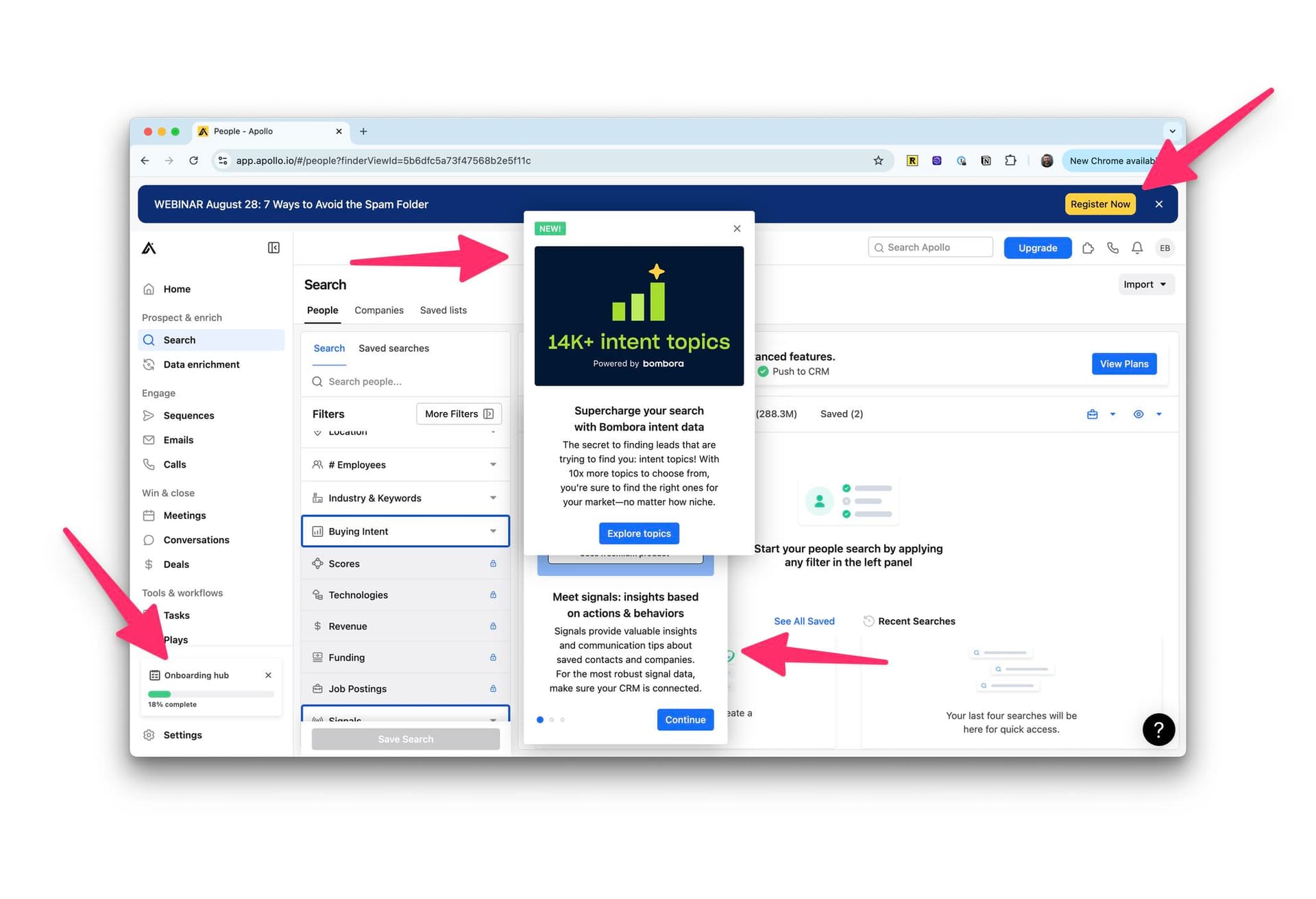
Here’s where this onboarding flow goes wrong:
- Overwhelms the user by hitting them with multiple overlapping promotions, upsells, and CTAs at once
- Creates frustration and disempowerment by bombarding users before they can even start their intended task
- Floods the experience with noise instead of strategically guiding attention to what matters
- Prioritizes the company’s goals over the user’s goals, making the product experience feel self-serving rather than helpful
- Introduces cognitive overload by asking the user to process too much information at the wrong moment
- Disrupts forward momentum by forcing users to sift through distractions instead of progressing smoothly toward their own objectives
The moral of the story here: It’s not enough to just have product onboarding. Your onboarding needs to be carefully strategized, based on best practices, and iterative.
It’s no surprise to anyone that we’re in the midst of a revolution. AI is changing the product onboarding game in a big way by unlocking a new set of tools, tools that understand not just what your product does, but what your user is trying to do. And that changes everything.
Here’s what AI-powered onboarding can unlock:
No more one-size-fits-all walkthroughs. AI can tailor the onboarding journey based on who the user is, what they’ve done, and what they still need to do.
AI doesn’t have to wait for users to get stuck. It can anticipate roadblocks and offer the right help at the right time, noticing you hesitating before you even ask a question.
AI can respond to what’s actually happening in the moment, showing tooltips, nudges, or instructions when they’re needed most.
AI tools learn from every user interaction, constantly improving the experience and identifying new friction points without manual analysis.
In short, we think there’s huge upside to integrating AI into your product onboarding process.
To that end, we’ve been building our own solution over here: the Frigade Assistant, an in-app AI agent designed to support users from the moment they sign in.
The flow-builder generation of onboarding tools (Pendo, Userpilot, Chameleon) is fundamentally about static onboarding that someone on your team has to keep authoring and maintaining as the product changes. The Frigade Assistant is a different shape. It learns your product the way a real user would, then adapts on two axes that flow-builders cannot:
- Adapts to the product. When you ship a UX change, the Assistant re-learns the new flow on its own. Tours rot. Agents update themselves.
- Adapts to the user. Each user gets guidance tailored to what they are trying to do right now, based on their behavior and intent, instead of the same authored checklist everyone else got.
The Assistant works in two modes. On demand, a user asks "how do I do X" and the agent walks them through it. Proactively (Frigade Suggestions), the agent surfaces AI-driven tours and contextual nudges on its own, personalized per user and timed to the right moment, so the user does not have to think to ask. It also performs actions on the user's behalf (form fills, navigation), detects friction in real time, and escalates to your support stack with full context attached when needed. Basically, it's the next best thing to sitting beside your user, helping them click, configure, and succeed.
Used in production by SaaS teams who want autonomous in-product guidance instead of a maintenance-heavy library of authored flows.
If you’re interested in a quick demo, grab some time here.
The biggest takeaway: Regardless of the specific tools, strategies, and AI you use, know that product onboarding is bigger than onboarding. It’s not just a UX consideration. It’s not just a support tool. It’s a growth strategy that touches every part of your business.
When you get it right, it lifts everything else:
- Marketing lands better, because users actually stick around to see the promise fulfilled
- Product gets better quality feedback, because users know what to do
- Support spends less time answering the same five questions
- And leadership sees the retention curve rise
Essentially, if you invest in great onboarding now and treat it like the ongoing, evolving experience it is, your users will thank you and so will your metrics.
And as always, if you need help: Hit us up over at Frigade. We love this stuff over here.