If you’ve landed here searching for Pendo alternatives, congratulations, you’ve found the right place.
Below, I’ll walk you through five alternatives, giving the high points alongside my expert opinion, without a bunch of fluff that wastes your time. No affiliate links, no paid promos, just a genuinely useful roundup.
I will mention Frigade, our own AI-powered onboarding platform, but only because it’s relevant and solves this exact problem.
Over the years, I’ve watched countless friends and colleagues wrestle with tools that promise frictionless onboarding… but just end up feeling like brittle overlays glued onto your product.
Don’t get me wrong, Pendo isn’t a bad platform. It works at scale, its analytics are slick, and some teams swear by it.
But when you start asking why the same flow you authored last quarter is already broken, or why your team is still hand-rebuilding tours every release, you start looking for a better way.
There is one, and my team built it. It’s called the Frigade Assistant: an AI agent that learns your product on its own, walks users through real workflows on demand, and adapts as you ship. No tours to author. No selectors to fix when your CSS changes.
Plus, Pendo is just so expensive for what it is. And you don’t find out until after the demo, since their pricing is gated.
With that in mind, let’s look at the five top alternatives to Pendo, based on my experience, and what kinds of teams I think they’re best for.
Here’s an overview of 5 popular alternatives and their features, or lack thereof...
| Feature | Chameleon | Appcues | Userpilot | Intro.js | Frigade |
|---|---|---|---|---|---|
| Onboarding Flows | ✅ Yes | ✅ Yes | ✅ Yes | ⚠️ Limited | ✅ Yes |
| Code-based | ❌ No | ❌ No | ❌ No | ✅ Yes | ✅ Yes |
| Product Analytics | ⚠️ Limited | ⚠️ Limited | ✅ Yes | ❌ No | ✅ Yes |
| Feedback / NPS | ⚠️ Limited | ✅ Yes | ⚠️ Limited | ❌ No | ✅ Yes |
| Self-hosting | ❌ No | ❌ No | ❌ No | ✅ Yes | ✅ Yes |
| Intelligent in-app assistant | ❌ No | ❌ No | ❌ No | ❌ No | ✅ Yes |
Here’s who, in my opinion, would benefit most from each of these alternatives to Pendo:
- The Frigade Assistant: Teams that want to stop authoring tours and let an AI agent guide users through real workflows on demand
- Chameleon.io: Teams who don’t need deep customization and require a low-engineering lift
- Appcues: Mid-market SaaS teams that prefer a no-code approach
- UserPilot: Growth teams that prefer a no-code approach
- Intro.js: Indie businesses, startups, and small businesses that have limited resources but have engineering support
We built the Frigade Assistant because, after years of helping teams ship product onboarding, we kept watching the same pattern: a team would author a tour in Pendo or Userpilot, the tour would work for a quarter, the product would change, and the tour would silently rot. The flow-builder generation is fundamentally about static onboarding that someone on your team has to keep authoring and maintaining forever. None of them solve the rot, because the rot is the architecture.
The Frigade Assistant is a different shape. It is an AI agent that learns your product the way a real user would, then operates in two modes you cannot get from a flow-builder:
- On demand. A user asks "how do I do X" and the Assistant walks them through the workflow, fills forms on their behalf, and escalates to support with full context attached if needed.
- Proactive (Frigade Suggestions). The Assistant also delivers AI-driven tours and contextual nudges on its own, surfaced at the right moment for each user. Personalized per user instead of authored once for everyone, and they re-adapt automatically as your product changes.
It also adapts on two axes that flow-builders cannot:
- Adapts to the product. When you ship a UX change, the Assistant re-learns the new flow on its own. There is no flow for your team to update. There is no selector to fix when your CSS changes.
- Adapts to the user. Each user gets guidance tailored to what they are trying to do right now, based on their behavior and intent, instead of the same generic checklist everyone else got.
Why teams pick it as a Pendo alternative:
- No flows to author or maintain. Pendo and Userpilot are static-flow factories. The Assistant is autonomous; the maintenance burden goes to zero.
- Both reactive and proactive. It guides users on demand and surfaces suggestions on its own. You do not have to choose between "tour everyone" and "wait until they ask."
- Multi-step workflows, not just static tooltips. The Assistant can guide a user through "create a project, invite a teammate, set up a webhook" as a single conversational flow, filling forms and clicking buttons on their behalf. A flow-builder cannot do this without a fragile cascade of authored steps that breaks the moment any of them changes.
- Detects friction in real time. The Assistant watches user behavior, identifies where users are getting stuck, and intervenes inline. It also escalates to support (Zendesk, Intercom, etc.) with full context attached when it cannot resolve an issue, which collapses your support volume.
- Adapts as the product changes. Authored tours rot the moment your UX evolves. The Assistant re-learns the product on its own, so guidance stays current without anyone editing a flow.
- Self-hostable. Unlike Pendo's closed-source overlay, Frigade can run entirely on your infrastructure if your security posture requires it.
If you have a healthy product and want to stop authoring (and maintaining) static flows that go stale every time your product evolves, this is the modern Pendo alternative.
Take a look at some real onboarding patterns in the Product Onboarding Example Library.
Chameleon lets you get simple tours up and running without writing a line of code, which can be handy when time and engineering resources are tight.
However, you’ll trade off deep customization, self‑hosting, and advanced analytics for that convenience.
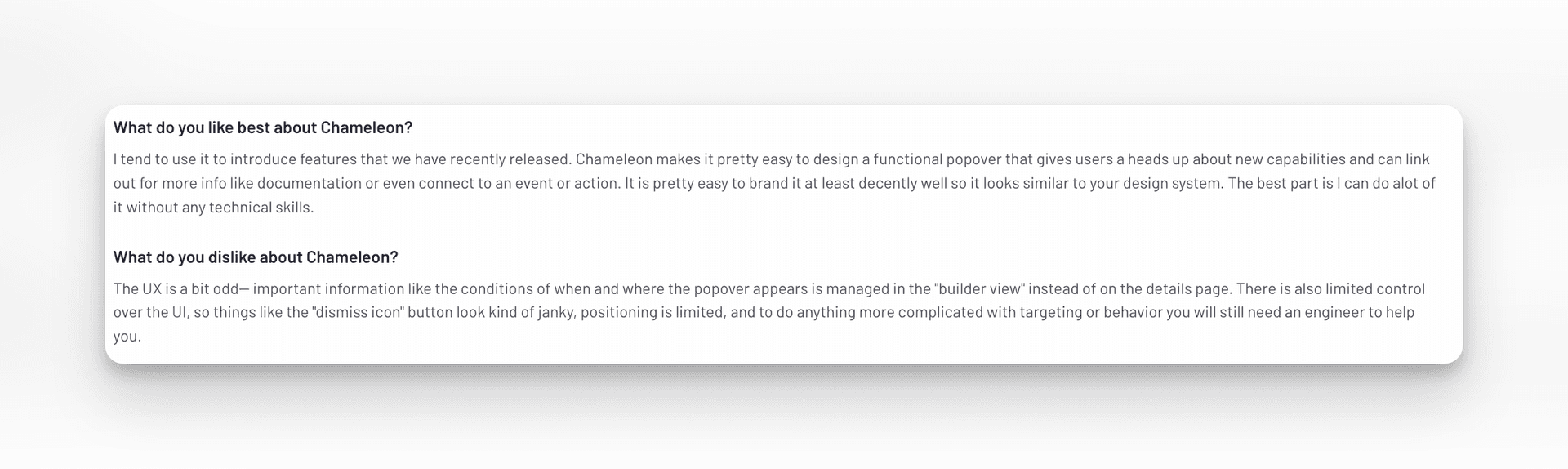
One G2 reviewer noted that:
“There is also limited control over the UI, so things like the ‘dismiss icon’ button look kind of janky, positioning is limited, and to do anything more complicated with targeting or behavior you will still need an engineer to help you.”
📚 Read more: Build Product Tours That Don’t Suck
Teams that Chameleon could be good for:
- Product teams that need a no‑code or low‑code solution and don’t require advanced analytics.
- Companies willing to trade off deep customization for implementation speed.
Why I included it in this list of Pendo alternatives:
- The visual, drag‑and‑drop editor gets you live without involving engineering.
- The built-in templating library does include the most basic onboarding patterns.
While some teams may find Chameleon the right fit, others could find it falling short. It has 4.2 out of 5 stars on G2, which is the lowest star rating out of this group.
And another G2 reviewer reports that:
“Sometimes, I find the design customisations to be a bit lacking – there are no options to adjust the distance between text and padding or the button padding. That might be to keep it easy-entry for some people.”
But it’s still a Pendo alternative that should be mentioned here.
Appcues delivers no‑code onboarding flows that are easy to set up, but don’t expect powerful analytics or self‑hosting flexibility.
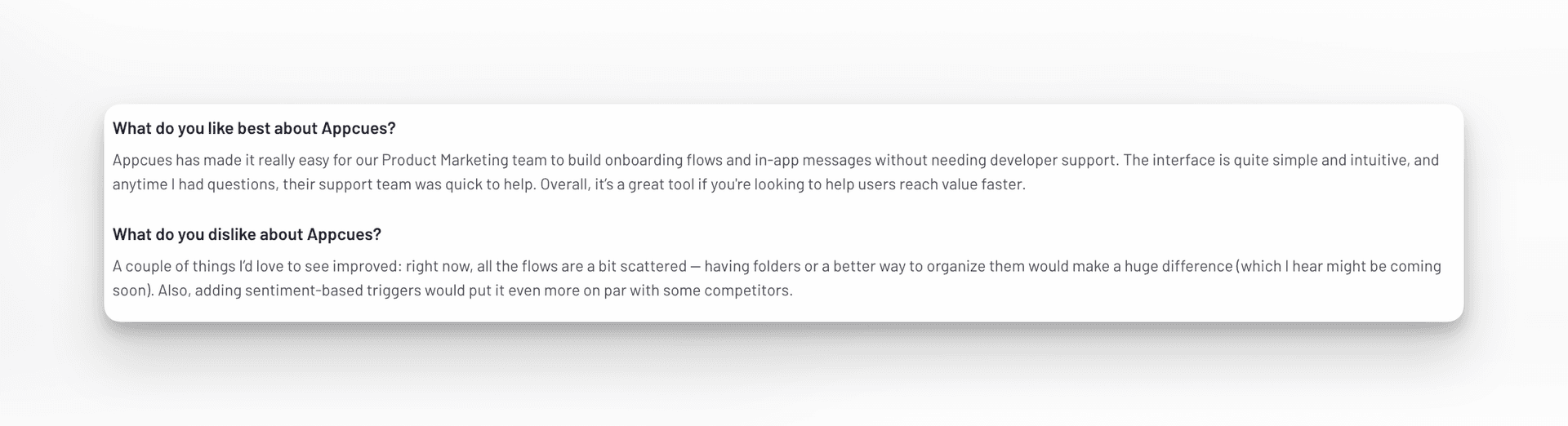
Marianna N. notes the following in her recent feedback of the software:
“A couple of things I’d love to see improved: Right now, all the flows are a bit scattered—having folders or a better way to organize them would make a huge difference… Also, adding sentiment‑based triggers would put it even more on par with some competitors.”
Teams that Appcues could be best for:
- Mid‑market SaaS vendors who need solid in‑app guidance with some basic analytics.
- Teams that prioritize ease‑of‑use over deep technical control.
Why I included it in this list of Pendo alternatives:
- Intuitive flow builder with a range of pre‑built templates.
- Native support for in‑app announcements, tooltips, and hotspots.
Overall, as of the date of this writing, Appcues has 4.6 out of 5 stars on G2.
But Luiza V. mentions:
“Actually, my dev team hates Appcues,”
…and if you've been in the product world for a while… well, you don’t want to upset the devs.
🧠 Learn more: Iterating Your User Onboarding Flow: A Practical Guide For Better Results
Userpilot strikes a balance between no‑code simplicity and developer‑friendly flexibility, but it still can’t truly match Pendo’s depth when it comes to built‑in NPS and feedback surveys.
And, full disclosure, the Frigade Assistant still outperforms when it comes to actually getting users to value, because it does not require anyone to author a flow in the first place.
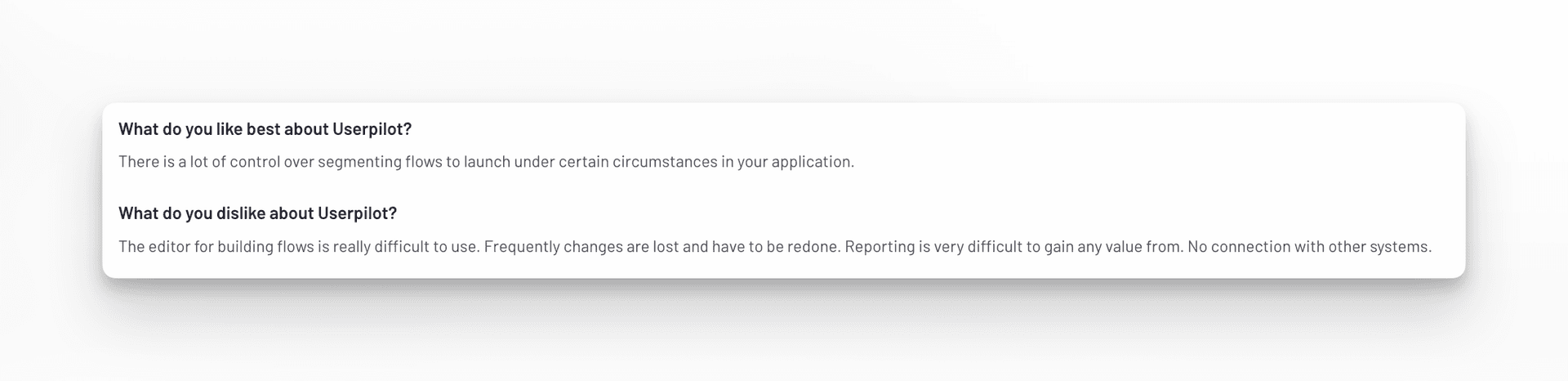
One reviewer notes that Userpilot’s:
“Editor for building flows is really difficult to use”
and that, frequently,
“Changes are lost and have to be redone.”
UserPilot could be best for teams that need:
- Both onboarding flows and reasonable product analytics without self‑hosting
- To experiment quickly with in‑app experiences
- Minimal engineering overhead
Why I included it in this list of Pendo alternatives:
- Good hybrid of no‑code flow builder plus tag‑based analytics
- Resource center and NPS capabilities built in
📚 Read more: How to Build Effective Product Checklists
UserPilot has 4.6 out of 5 stars on G2, so many people find it a good fit.
But marketing manager Erica G. shares that:
“UserPilot is a bit time-consuming. We have to test it thoroughly because it does not always work perfectly,”
…which kind of defeats a bit of the point of low-to-no code onboarding tools.
If you’re comfortable coding your own tours, Intro.js offers a no‑frills, self‑hosted solution, but don’t expect the bells and whistles of a full digital adoption platform.
Intro.js could be best for teams that:
- Are indie/startups or small businesses with in‑house developers
- Need ultra‑lightweight, self‑hosted tutorials without any analytics
- Have limited budget for an investment in a platform
Why I included it in this list of Pendo alternatives:
- Open‑source, with zero vendor lock‑in. Love it, because I love code-based onboarding flows
- Simple API for crafting step‑by‑step guides directly in your code
As a code-based tool option, I’d argue it’s a better way to do in-app product onboarding.
💡 Pro-tip: If you’re on a team with limited resources, sometimes during the initial building stages, open source is the smart first step. Check out our guide on best tools for building product onboarding for a couple open-sourced React library recommendations.
I’m not here to throw shade at Pendo.
They’ve built a fantastic product that scales and works for many teams.
But it isn’t the best fit for every organization, especially if you believe, as I do, that code‑based onboarding flows that look and feel native are better.
- Static flows that go stale. Every tour, checklist, and tooltip is authored manually and stays exactly that way until someone on your team rewrites it. When your product changes, the flows do not. They quietly rot.
- Pricey and opaque: Pricing isn’t transparent and many people are frustrated with the pricing. Just take a look at this discussion in r/SaaS to see what’s up.
- Closed‑source: No self‑hosting or full data control, which raises privacy concerns.
- Performance hit: Extra JS payload can slow down your app, especially on mobile or slower connections.
- “Low‑code” ≠ no‑code: Still requires significant dev support and tagging maintenance. That’s not cool if you’re expecting a lighter lift on your dev team.
- Brittle guides: Minor UI changes can break your flows overnight. No thanks.
- One-size-fits-all for users: Every user gets the same authored flow, regardless of intent. There is no per-user adaptation.
This comment in a r/UXResearch discussion brings out some of my concerns on the functions of the platform:
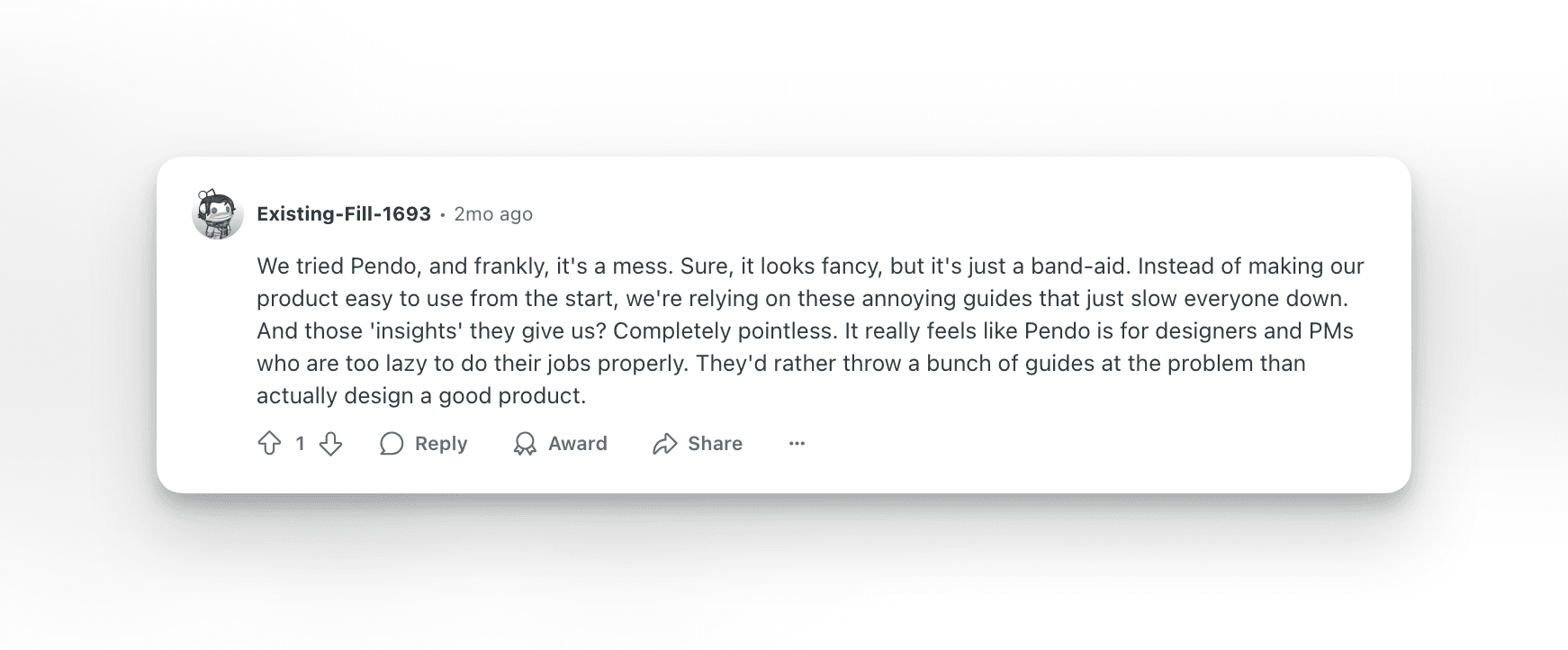
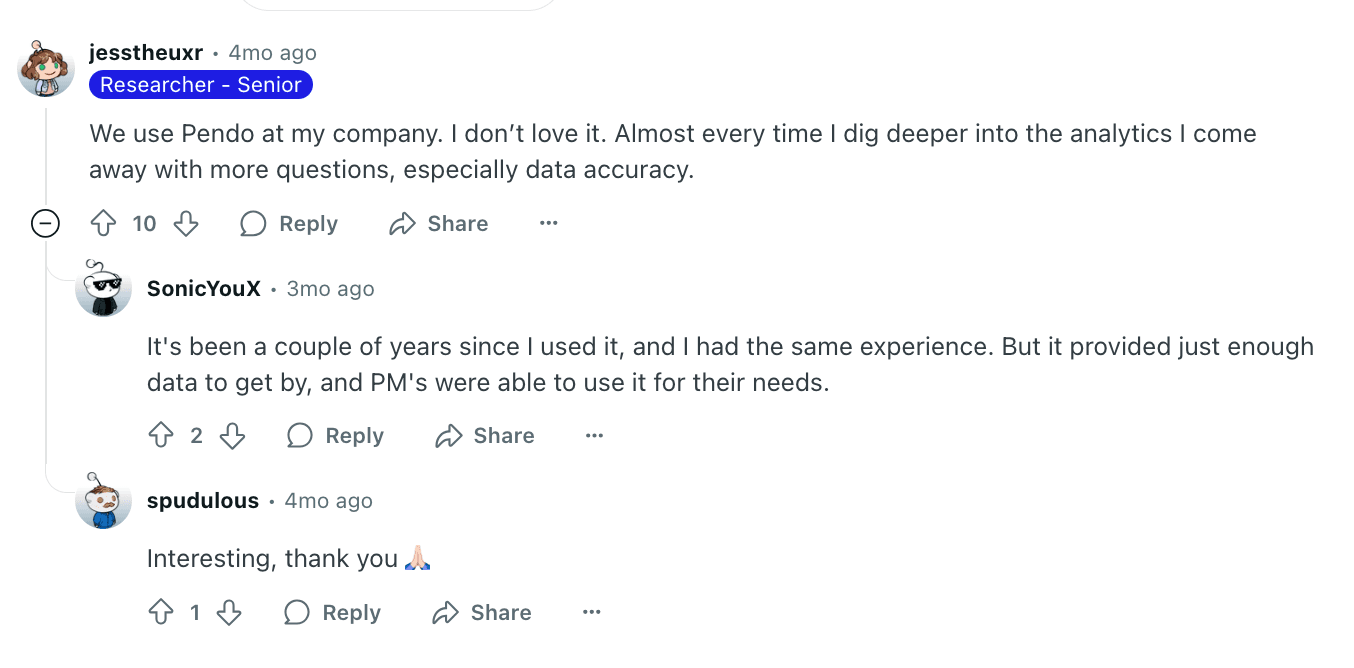
And it also seems consistent over time in discussion forums that, despite its user-loved analytics, there are some concerns about data accuracy.
If you are tired of authoring tours that rot the moment your product changes, the Frigade Assistant is the modern alternative you’ve been searching for.
The Frigade Assistant is an intelligent in-app agent designed to support users from the moment they sign in. Instead of authoring flows in a dashboard, you connect the Assistant to your product and it learns the product by using it the way a real user would. From there it can:
- Generate personalized step-by-step guides for any workflow, on demand.
- Deliver proactive AI tours and Frigade Suggestions on its own, surfaced at the right moment per user instead of authored once for everyone.
- Take actions directly on your users’ behalf (form fills, navigation, feature activation) for a frictionless experience.
- Answer open-ended questions about your product in plain language.
- Integrate with Zendesk, Intercom, and more for handoff to live support with full context attached.
- Requires little to no engineering setup to install and train.
- Adapts automatically to product changes, with no flow maintenance burden.
It is the next best thing to sitting beside each user as they try your product and guiding them in person, and unlike a static authored tour, it works whether the user thinks to ask or not.
Nicu says "This product is a game-changer… it truly understands and eases the often tricky challenges of onboarding and feature adoption."
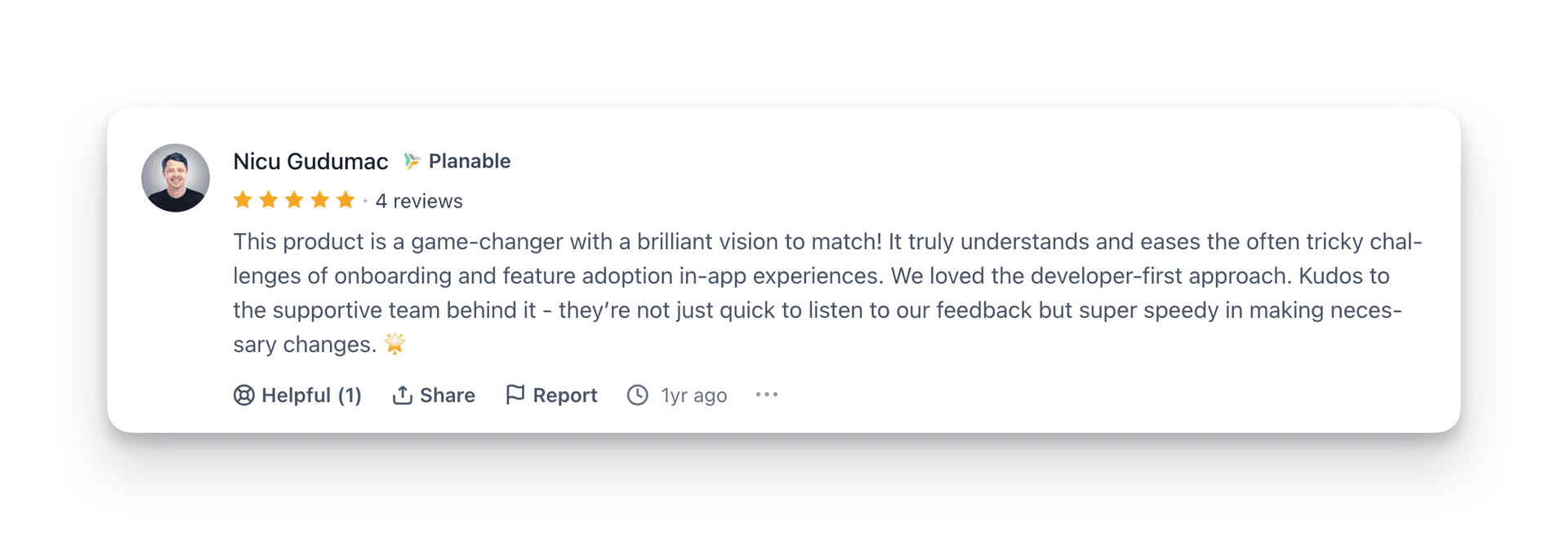
Thanks for your kind review, Nicu!
So, yeah, I think it makes a great Pendo alternative.
The Frigade Assistant is the right starting point for most teams replacing Pendo. But there are still moments where you specifically want an authored surface with full pixel-perfect control: a one-time launch banner or an NPS survey.
For those cases, we ship Frigade Engage: a code-first React component library that lets you build product onboarding the way your engineers build the rest of your app. Components live in your codebase. They’re versioned with your product. They don’t rot the way no-code overlays do, because they’re code.
If you believe (as I do) that product onboarding should be built in code, with full control and seamless integration into your product, this is the part of Frigade you’ll spend time in. It pairs naturally with the Assistant, which handles the open-ended questions and walkthroughs you don’t have time to author by hand.
Most teams that pick Frigade as a Pendo alternative start with the Assistant and add Engage components for the handful of surfaces where authored control is the genuine requirement.